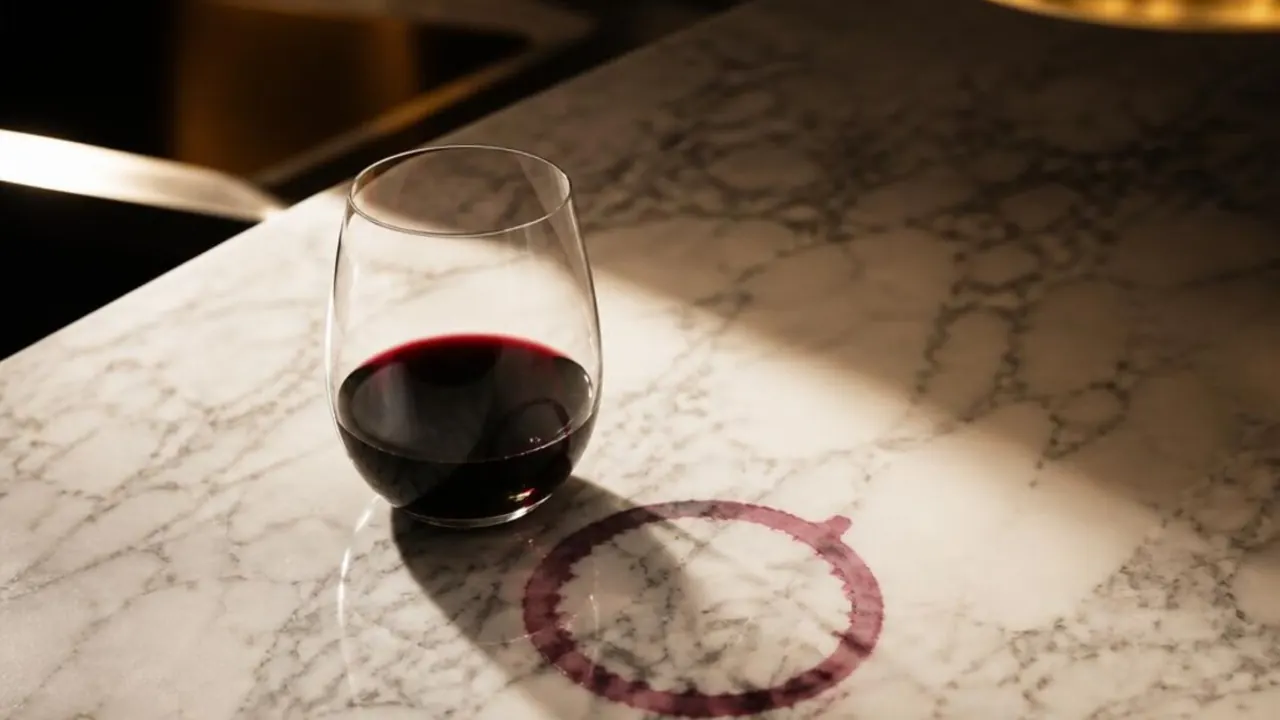
The reason marble stains so easily comes down to its structure. Under magnification, marble is full of microscopic pores and tiny channels between its mineral crystals. Those pores give marble its characteristic depth and veining, but they're also open doorways for anything liquid. Oil-based substances migrate into the stone and darken it from within. Water-based liquids like coffee or juice carry pigment into the same pores and leave behind a colored stain once the liquid evaporates. The stone doesn't have to be old, cheap, or poorly finished for this to happen. It's simply how calcium carbonate behaves.
It's worth separating staining from a related but different problem: etching. Staining is absorption, a liquid gets into the stone's pores and leaves color behind, but the polished surface itself is still intact. Etching is a chemical reaction: acid from something like lemon juice, vinegar, or a common cleaning product dissolves the calcium carbonate at the surface, leaving a dull, rough patch even after you wipe it away instantly. A stain is a color problem. An etch mark is a surface-damage problem. Marble is vulnerable to both, and homeowners commonly mistake one for the other.
Sealers are the traditional response to staining, and they do work, temporarily. A penetrating sealer fills the stone's pores with a resin that repels liquid for a while, buying you time to wipe up a spill before it soaks in. But sealers sit in the pores rather than bonding to them, and that seal breaks down with foot traffic, cleaning chemicals, and normal wear. Most sealers need reapplication every one to three years, and in the gap between applications, the stone is just as vulnerable as if it had never been sealed at all. Sealing marble is maintenance, not a fix.
RAKU nanocoating takes a different approach. Rather than functioning like a traditional penetrating sealer, it is professionally applied to the stone to help reduce liquid absorption and surface damage. A certified applicator should assess the specific stone and use case before treatment; quartz should not be treated without documented, material-specific testing. Application and cure timing depend on the system and conditions, with an approximate six-day cure period to be confirmed by the applicator. Based on the available service information, expected service life is about 10 years in residential settings and 3–5 years in commercial settings; these are expectations, not warranty terms. Do not treat the surface as food-contact certified or assume it is impervious, permanent, or heat-proof.
If you're weighing your options for protecting marble, onyx, quartzite, travertine, or limestone, read our full guide to marble sealing to understand exactly how traditional sealers work, where they fall short, and how a professionally assessed RAKU treatment may help reduce staining on suitable natural stone.
Sources for stone-care guidance
These references support general stone-care guidance, not Marble Armour product performance claims.
- Natural Stone Institute, Care & Cleaning of Natural Stone — Stone cleaning, stains, poultices, sealing and acid etching
Frequently Asked Questions
Does marble stain permanently?
It can. If a stain isn't caught and treated quickly, it can set into the stone permanently, especially oil-based stains. Some surface stains can be lifted with a poultice, but deep or old stains are often impossible to fully remove.
What stains marble the fastest?
Oil-based substances like olive oil, butter, and cooking grease stain marble fastest because they penetrate the pores almost immediately. Wine, coffee, and citrus juice are close behind due to their strong pigments and acidity.
Does sealing marble stop stains?
Sealing slows staining but doesn't stop it permanently. A sealer only repels liquid for as long as it remains intact, typically one to three years, after which the stone needs to be resealed to maintain protection.