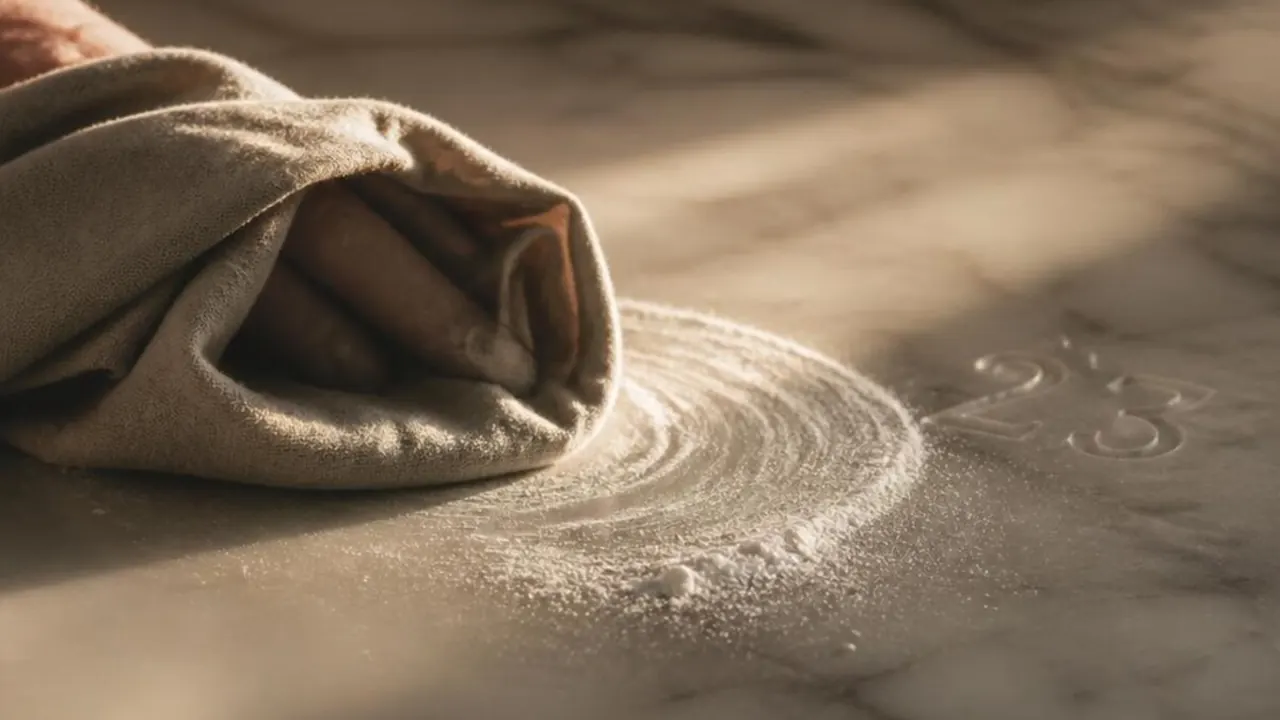
- Assess the severity of the etch. Not all etch marks are equal, and the right fix depends on how deep the damage goes. Light etches look like a dull, cloudy haze on an otherwise polished surface; you can usually feel that the stone is still smooth to the touch, since the damage is limited to the surface sheen. Deep or rough etches have a visible ring, a rough texture you can feel with your fingertip, or a noticeable dull spot that doesn't catch light the way the surrounding stone does. This assessment determines whether you can address it yourself or need a professional. If you're unsure why this happened in the first place, understand why marble etches before you do anything else; knowing the cause is the only way to stop repeating it.
- For light etches, try a marble polishing powder. For faint, shallow haze, a marble-specific polishing powder, never a generic household cleaner, can restore some shine. Apply it with a soft, damp cloth in small circular motions, working in one section at a time, then buff dry with a clean cloth. Understand what this actually does: polishing powder works by removing a microscopic layer of the stone's surface to expose fresh, unetched marble underneath. It is not repairing anything, it's sacrificing a tiny bit of stone to get back to a layer that hasn't been damaged. That's an important distinction, because it means polishing is not something to do casually or repeatedly. Every pass thins the marble a little more. Used occasionally on a genuinely light etch, it's a reasonable fix. Used as a routine response to ongoing acid exposure, it will visibly wear down your stone over time.
- For deeper etches, call in a stone restoration specialist. If the etch is rough to the touch, has a visible ring, or polishing powder doesn't bring back an even finish, you're past the point of a DIY fix. Deeper damage requires professional honing and repolishing, a controlled process that levels the surrounding stone to match the damaged area, then restores an even polish across the whole surface. This is precision work best left to a specialist, since uneven honing can create new problems, like flat or hazy patches that are just as noticeable as the original etch.
- Protect the surface so the cycle doesn't repeat. Here's the part most people skip: polishing or honing only resets the surface. It doesn't change the fact that your marble is still fully exposed to citrus, wine, vinegar, and every other acidic substance that caused the original mark. Without protection, the next spill etches it again, and you're back to step one, except with slightly thinner stone than before. Repair without prevention isn't a solution. It's a recurring maintenance cycle.
Professional Prevention: RAKU Nanocoating
Preventing repeat etching requires reducing acid contact and choosing protection appropriate to the stone. RAKU nanocoating may help reduce acid exposure when a professional confirms it is suitable, but it is not a permanent or invisible guarantee and acidic spills still require prompt cleanup.
Application, downtime, and cure timing must be confirmed with the applicator; an approximate six-day cure may apply. Expected service life is about 10 years residentially and 3–5 years commercially, not a warranty. No food-contact certification or specific heat rating is documented here, so do not assume either.
Polishing and honing address existing damage. A suitable professionally applied treatment may help reduce future exposure, but it does not replace careful use and prompt cleanup. If you're tired of repairing the same etch marks over and over, request a free estimate and ask a certified applicator about suitability, limitations, and care requirements.
Sources for stone-care guidance
These references support general stone-care guidance, not Marble Armour product performance claims.
- Natural Stone Institute, Care & Cleaning of Natural Stone — Stone cleaning, stains, poultices, sealing and acid etching
Frequently Asked Questions
Can etched marble be restored?
Not in the sense of reversing the damage; the dissolved layer of stone is gone for good. But most etch marks can be visually improved. Light etches often respond to marble polishing powder, while deeper etches typically need professional honing and repolishing.
Does polishing remove etch marks permanently?
Polishing removes a thin layer of the stone's surface to expose an undamaged layer underneath, which restores shine. It doesn't heal anything, and repeating it often will gradually thin your marble. It's a fix for an existing mark, not a repeatable routine.
How do I stop marble from etching again after repair?
Repair alone doesn't change your marble's vulnerability to acid; the surface is just as exposed as before. Use prompt cleanup and appropriate care, and ask a qualified professional whether a treatment is suitable for the specific stone. No treatment should be represented as preventing all future etching.