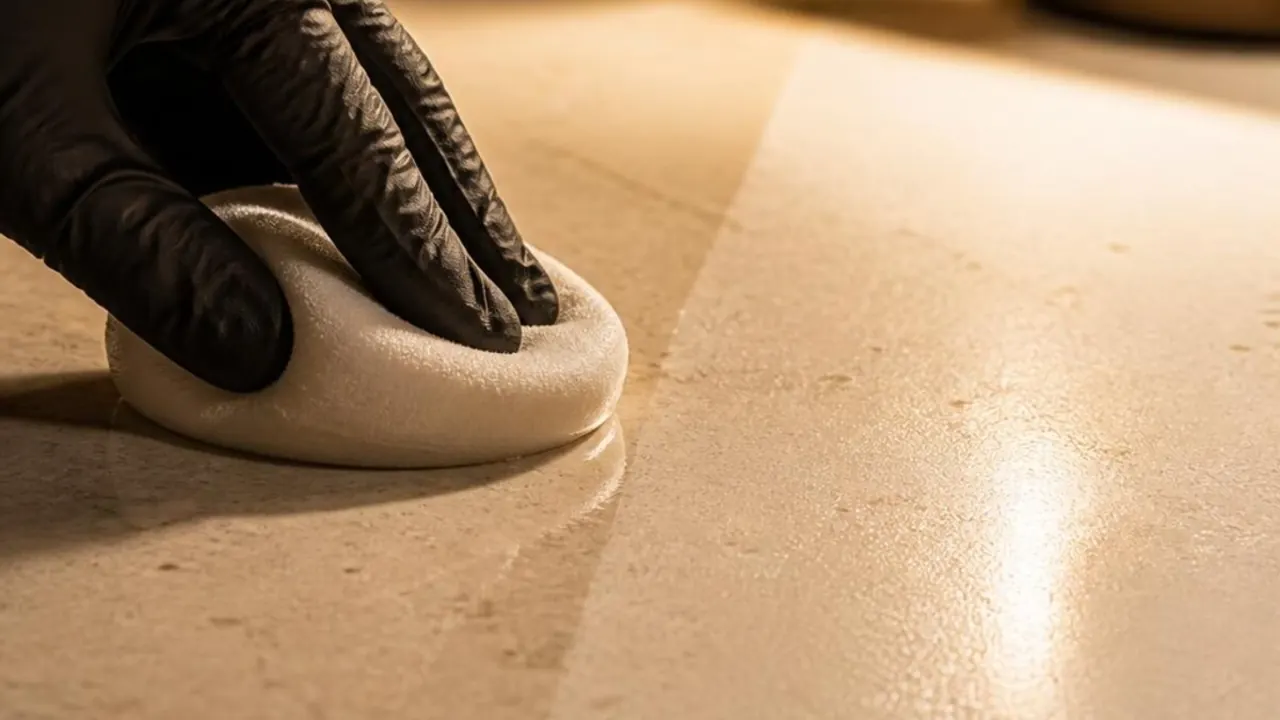
Here's how to evaluate your countertop and decide what kind of protection it actually needs.
- Clean and dry the surface completely. Wipe down the entire countertop with a mild, pH-neutral cleaner and let it dry fully. Any residue, grease, or moisture will mask existing damage and interfere with anything you apply afterward.
- Test for existing damage and etch marks. Once dry, inspect the surface under raking light, a flashlight held at a low angle works well, for dull spots, faint rings, or hazing near the sink and stove. These are early signs of acid or heat exposure. Run a hand across the surface too. A loss of sheen you can feel usually means the resin has already been affected.
- Do not select a RAKU treatment for quartz based on general marketing claims. Quartz formulations vary, and no material-specific compatibility testing is documented here. Follow the quartz manufacturer's care guidance and obtain professional assessment and written confirmation of suitability before considering any product.
- If a professional confirms a treatment is suitable for another natural-stone surface, follow the applicator's instructions for preparation, application, and cure. An approximate six-day cure may apply, but the applicator must confirm the actual timing. Expected service life is about 10 years residentially and 3–5 years commercially, not a warranty, and no food-contact certification or specific heat rating should be assumed.
Why Quartz and Marble Aren't the Same Conversation
Marble is a natural stone with high porosity. Its surface is full of microscopic channels that absorb liquid, oil, and acid on contact, which is why traditional sealing, and eventually a permanent coating, is essential to prevent staining and etching. Quartz is engineered specifically to minimize that porosity, combining crushed stone with resin under pressure to create a much tighter, less absorbent surface. That's why quartz rarely stains from everyday spills the way unsealed marble does. But low porosity doesn't mean invulnerable. Quartz's resin content is exactly what makes it vulnerable to heat and certain chemicals, a different failure mode than marble's absorbency. The protection strategy has to match the material, not just the marketing term "sealing."
Do not assume a coating is suitable for quartz's specific vulnerabilities without material-specific testing and professional assessment. If you're dealing with natural stone like marble, onyx, or travertine, where porosity actually is the core issue, read our marble sealing guide for the full breakdown.
Sources for stone-care guidance
These references support general stone-care guidance, not Marble Armour product performance claims.
- Corian Quartz, Care & Maintenance — Manufacturer guidance for engineered quartz surfaces
Frequently Asked Questions
Do you need to seal quartz countertops?
Not in the traditional sense. Quartz's resin content already makes it low-porosity, so it doesn't absorb liquids the way marble does. What quartz benefits from is protection against heat, acids, and solvents, which is a coating decision, not a pore-sealing one.
Can quartz countertops be damaged by heat?
Yes. The resin binder in engineered quartz can scorch, discolor, or crack under sustained high heat, such as from a hot pan left directly on the surface. Always use a trivet, or protect the surface with a heat-resistant coating rated for high temperatures.
What is the best protection for quartz countertops?
Follow the quartz manufacturer's care instructions, use trivets and prompt cleanup, and seek professional assessment for damage. Do not assume RAKU or another coating is compatible without material-specific testing and written confirmation.