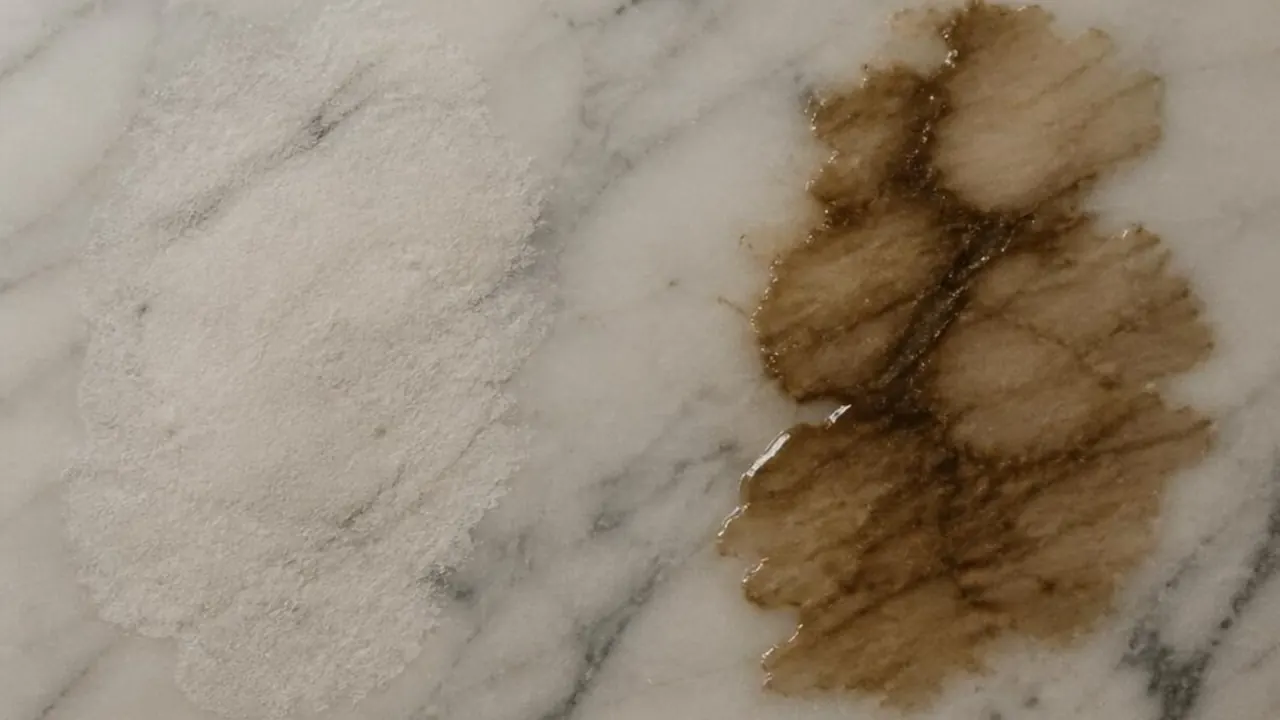
Etching can happen when acids react with calcium-based stones such as marble, limestone, travertine, and decorative onyx. Genuine quartzite is quartz-rich, not the same as those carbonate stones; mixed materials and mislabeled stones may behave differently and need individual assessment. On a susceptible surface, acidic spills can dissolve a microscopic layer, leaving a dull or rough patch even after the stone is clean and dry.
Staining happens for an entirely different reason. Marble is porous, and oils, pigments, and other liquids can soak down into those pores and sit there, darkening the stone from within. Because the material is physically inside the stone rather than chemically altered, staining can sometimes be drawn back out with a poultice that pulls the liquid out of the pores.
Here's how the two compare side by side:
| Etching | Staining | |
|---|---|---|
| Cause | Acid reacting with calcium carbonate at the surface | Liquid absorbing into the stone's pores |
| Appearance | Dull or rough patch, often pale or matte | Darkened, discolored area |
| Reversible? | No, the surface itself has changed | Sometimes, with a poultice |
| Does a sealer help? | No, sealers work in the pores, etching happens at the surface | Yes, slows absorption, buying time to wipe up spills |
| Does RAKU help? | Ask for product-specific acid-resistance evidence and suitability for the stone and finish; protection is not guaranteed | It may help reduce absorption on suitable surfaces; confirm product-specific evidence, limitations, and care instructions |
How to Tell Which One You Have
Run your hand over the mark. If it's smooth and just looks darker than the surrounding stone, you're likely dealing with a stain; the color has changed, but the surface hasn't. If the spot feels dull or slightly rough under your fingers, even after the stone has been fully cleaned and dried, that's etching. The texture change is the tell: staining alters color, etching alters the surface itself, and no amount of cleaning will smooth an etched spot back out.
The two are easy to mistake for each other at a glance, especially right after the damage happens, while the area may still look wet or shadowed. A quick touch test once the surface is dry is usually enough to sort out which you're actually facing, and it determines what you do next. A stain might respond to a poultice. An etch mark will not respond to any cleaning method, because there's no material to draw out; the stone's surface has permanently changed.
That's also why the two require different prevention strategies. A traditional sealer can genuinely help with staining, since it works exactly where staining happens, inside the pores. But it does nothing for etching, since etching happens above the pores, at the surface. A professionally assessed RAKU treatment may reduce both absorption and acid exposure on suitable natural stone, but it should not be described as permanent, impervious, or etch-proof. Confirm application and cure requirements with the applicator; expected service life is about 10 years residentially and 3–5 years commercially, not a warranty.
If you want the full picture on how etching happens and why it's permanent, read our full guide to marble etching.
Sources for stone-care guidance
These references support general stone-care guidance, not Marble Armour product performance claims.
- Natural Stone Institute, Care & Cleaning of Natural Stone — Stone cleaning, stains, poultices, sealing and acid etching
- Natural Stone Institute, A Deep Dive Into the Properties of Quartzite — Quartz-rich composition, material identification and acid behavior; not coating performance
Frequently Asked Questions
How do I know if my marble is etched or stained?
Touch the spot once it's fully dry. If it feels dull or rough, it's etched. If it feels smooth but looks darker, it's stained.
Can etching be confused with staining?
Yes, especially right after the damage occurs. Both can look like a dull or discolored spot at first glance. The surface texture, not the color, is what tells them apart.
Does RAKU protect against both etching and staining?
It may reduce staining and acid exposure on a suitable natural-stone surface, but performance depends on the material, preparation, application, use, and maintenance. It is not etch-proof or impervious; obtain a professional assessment and follow the applicator's care instructions.